Falling Film Evaporator: Working Principle, Advantages and Industrial Applications
Mar 27, 2026
Introduction
A falling film evaporator is an efficient thermal separation device widely used in chemical, pharmaceutical, and food industries. It is designed for continuous evaporation of heat-sensitive liquids under vacuum conditions, making it ideal for solvent recovery, concentration, and purification processes.
Among different evaporation technologies, the falling film design is known for its high heat transfer efficiency and short residence time, which helps prevent thermal degradation of sensitive materials such as ethanol, methanol, and organic compounds.
How a Falling Film Evaporator Works:
The working principle is based on the formation of a thin liquid film inside vertical heating tubes.
The liquid feed enters the top of the evaporator.
It is evenly distributed along the tube walls using a liquid distribution system.
A thin film forms and flows downward under gravity.
Heat is applied from the outside of the tubes, causing rapid evaporation.
Vapor and liquid are separated at the bottom and sent to different collection systems.
Because the liquid stays in the heating zone for a very short time, thermal damage is minimized.
Key Advantages of Falling Film Evaporator
1. High Heat Transfer Efficiency
The thin liquid film greatly increases the heat exchange surface, improving evaporation speed and efficiency.
2. Suitable for Heat-Sensitive Materials
Operating under vacuum allows evaporation at lower temperatures, protecting sensitive compounds from decomposition.
3. Continuous Operation
Unlike batch systems, falling film evaporators support continuous feeding and discharge, improving production efficiency.
4. Low Energy Consumption
Efficient heat utilization reduces energy waste, making it suitable for large-scale industrial applications.
5. Easy Observation and Control
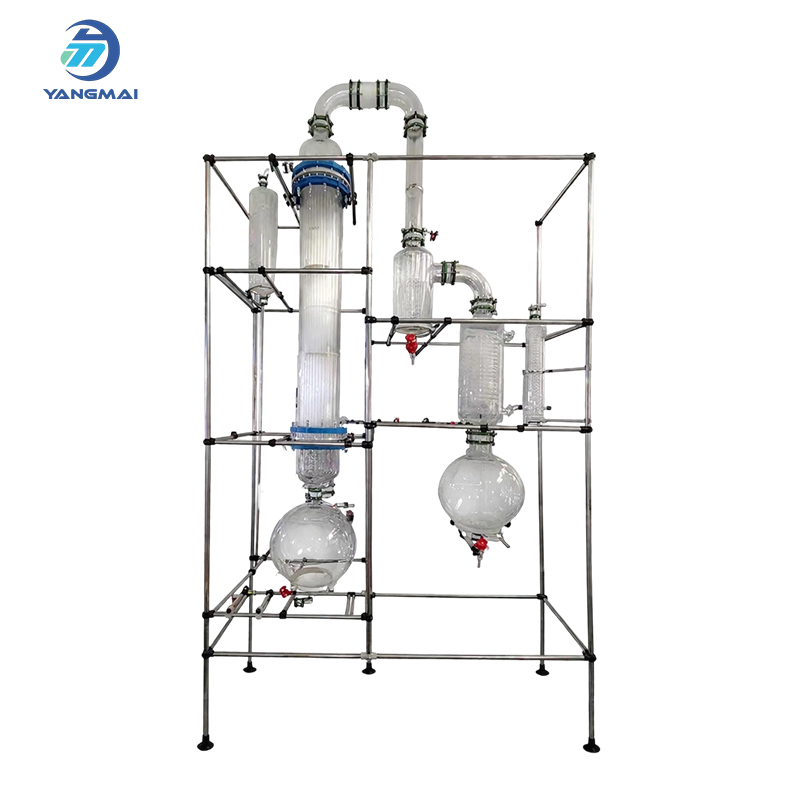
In glass systems, operators can visually monitor the entire evaporation process in real time.
Industrial Applications
Falling film evaporators are widely used in:
Pharmaceutical industry for solvent recovery and API concentration;
Chemical processing for organic solvent separation and purification;
Biotechnology for extraction and concentration of bioactive compounds;
Food industry for juice, flavor, and heat-sensitive liquid concentration;
Laboratory and pilot plants for reaction research and process optimization;
Typical processes include ethanol recovery, esterification reaction concentration, and volatile solvent distillation.
Glass Falling Film Evaporator Advantage
Compared with metal systems, a glass falling film evaporator provides:
Excellent corrosion resistance
Full process visibility
Better suitability for laboratory and pilot-scale research
Easier cleaning and maintenance
This makes it especially popular in research institutions and small-to-medium production environments.
Conclusion
The falling film evaporator is a highly efficient solution for continuous evaporation and solvent recovery. Its combination of high heat transfer efficiency, low operating temperature, and compatibility with sensitive materials makes it an essential equipment in modern chemical and pharmaceutical processing.
Whether used in laboratories or industrial pilot plants, it provides stable performance and reliable results for a wide range of applications.