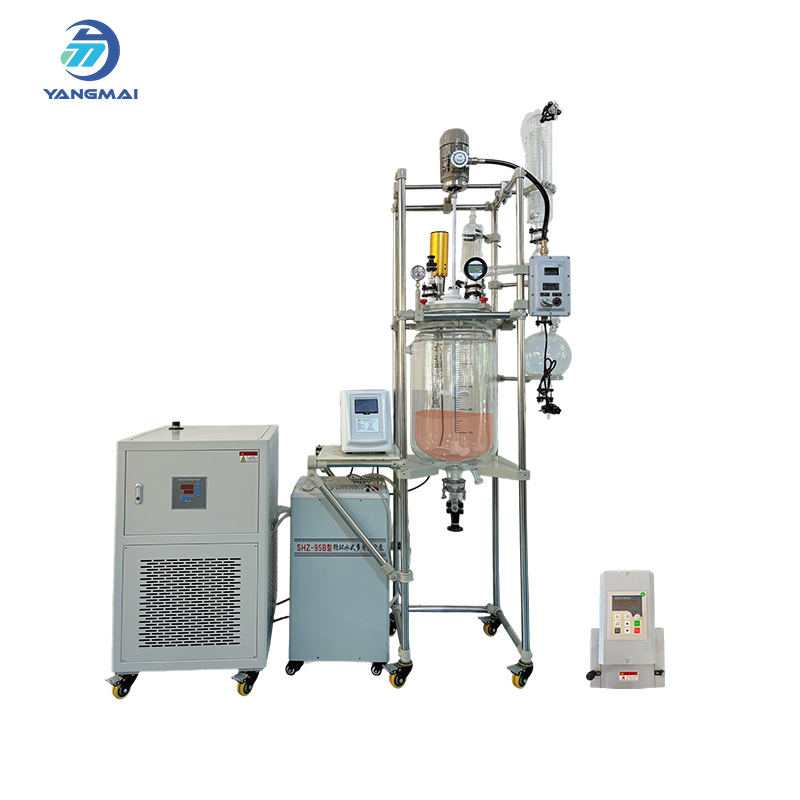
Ultrasonic Glass Reactor: Key Design Considerations
Nov 19, 2026
Ultrasonic technology is widely used in nanoparticle dispersion, cell disruption, emulsification, and other industrial processes. While small ultrasonic probes work well in laboratories, integrating ultrasonic technology into an industrial glass reactor requires more careful engineering.
Simply installing an ultrasonic probe through the reactor lid is not enough. Sealing, vibration control, power selection, probe positioning, and temperature management all affect equipment performance.
Here are five important factors to consider when designing an ultrasonic glass reactor.
1. Reactor Structure and Sealing Design
An ultrasonic probe operates through high-frequency mechanical vibration, unlike a conventional rotating agitator shaft.
When installed through a glass reactor lid, these vibrations may be transmitted to the mounting structure and surrounding components.
Poor installation may result in:
Vacuum leakage or liquid leakage
Excessive vibration at the mounting interface
Additional stress on glass components
Unstable long-term operation
Therefore, ultrasonic glass reactors should ideally have a dedicated probe installation port and a suitable sealing structure.
Depending on the application, a specially designed PTFE lid, mounting flange, and sealing assembly may be considered. The entire structure should be engineered to maintain sealing performance while managing vibration transmission.
2. Ultrasonic Power and Frequency Selection
Choosing the right ultrasonic power is essential. Higher power does not always mean better performance.
The selection should consider reactor volume, material viscosity, solid content, target particle size, and processing requirements.
Common industrial power options include:
Typical Application
2KW
Low-viscosity materials and general dispersion
3KW
General dispersion and emulsification
4KW
More demanding dispersion processes
These are reference configurations. Actual power requirements should be confirmed through process testing.
Frequency is another important factor:
20 kHz: Commonly used for intensive cavitation, particle deagglomeration, and nanoparticle dispersion.
40 kHz: May be suitable for applications requiring different cavitation characteristics and more controlled processing.
The ultrasonic probe length and installation depth must also match the reactor dimensions, ensuring sufficient clearance from the agitator blades and reactor bottom.
3. Proper Operation and Temperature Control
Correct operating procedures help improve processing efficiency and extend equipment service life.
Three basic principles should be followed:
First, ensure the probe is immersed in liquid. Operating without sufficient liquid coverage may damage the ultrasonic probe.
Second, start mechanical stirring before ultrasonic processing. Agitation helps circulate the material and distribute the ultrasonic treatment more evenly.
Third, pay attention to temperature control. Ultrasonic cavitation generates additional heat. For temperature-sensitive materials, pulse operation and sufficient cooling capacity can help control temperature increases.
The heating and cooling circulator should be selected according to both the process heat load and the additional heat generated by ultrasonic operation.
4. Common Problems During Ultrasonic Operation
If ultrasonic processing becomes less effective over time, check the following components:
Generator output: Check whether the output power and frequency tracking are operating normally.
Material temperature: Excessive temperature increases may affect cavitation efficiency.
Mounting assembly: Check for loose connections, abnormal vibration, or unusual noise.
Ultrasonic probe: Inspect the probe tip for discoloration, surface pits, or cavitation erosion.
Regular inspection and proper cleaning can help maintain stable operation.
5. Can an Existing Glass Reactor Be Upgraded?
Some modifications are relatively easy, while others require structural redesign.
Electrical upgrades, such as generator replacement and control system improvements, may be possible depending on the existing configuration.
However, the following components should ideally be considered during the initial design stage:
Ultrasonic installation port
Reactor lid material and sealing structure
Probe length and installation position
Clearance between the probe and agitator
Temperature control capacity
Explosion-proof requirements, where applicable
For this reason, integrating ultrasonic technology during the initial reactor design is generally more practical than modifying an existing glass reactor.
Customized Ultrasonic Glass Reactor Solutions
As a glass reactor manufacturer, we provide customized reactor configurations according to different process requirements.
To recommend a suitable ultrasonic reactor, we need to understand:
Required reactor volume
Material viscosity and solid content
Ultrasonic processing purpose
Required temperature and operating conditions
Mechanical stirring and vacuum requirements
Based on these details, we can evaluate the reactor structure, ultrasonic system, and temperature control configuration.
Contact us to discuss your application and find a suitable ultrasonic glass reactor solution.
https://www.youtube.com/embed/gzXTBAuD3kQ