Glass Filter Reactor: Should Your Solids Stay or Go?
Oct 20, 2026
In many chemical and pharmaceutical processes, the reaction is only part of the job. After the reaction, the solid product or carrier must be separated from the liquid, washed repeatedly, and sometimes retained for the next processing step.
If every filtration and washing cycle requires transferring the solids to another vessel, material loss, contamination risks, and processing time can quickly add up.
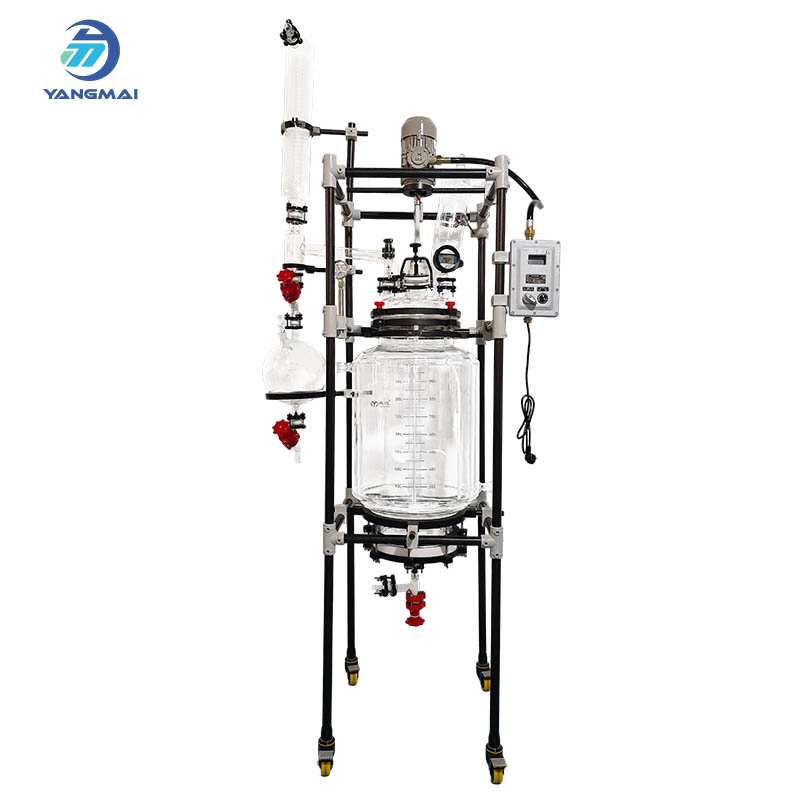
A glass filter reactor integrates reaction, solid-liquid separation, and washing in one vessel. It is particularly useful for processes in which the solid phase is the main product, a functional carrier, or a valuable catalyst.
So, how do you determine whether a glass filter reactor is the right choice for your process?
1. The Key Question: Does the Solid Need to Stay in the Vessel?
The main difference between a conventional glass reactor and a glass filter reactor lies in the bottom filtration assembly.
A glass filter reactor typically incorporates a filter plate or another suitable filtration structure at the bottom of the vessel. During filtration, the liquid passes through the filter medium while the solids remain inside. Washing liquid can then be introduced to rinse the retained solids before being drained through the filtration outlet.
This allows reaction, filtration, and repeated washing to take place in the same vessel, reducing the need to transfer solids between separate pieces of equipment.
By contrast, repeatedly removing solids for external filtration and returning them to the reactor creates additional handling steps. Depending on the material and process, these transfers can increase product loss, contamination risks, and processing time.
A simple selection rule: after the reaction, should the solid be removed or retained?
If the solid needs to remain in the vessel through multiple filtration and washing cycles, a glass filter reactor may be worth evaluating.
Four Applications in Pharmaceutical and Biochemical Processing
Peptide Synthesis
In solid-phase peptide synthesis, the growing peptide chain is attached to a solid resin. After each coupling or deprotection step, excess reagents and by-products must be removed through washing.
A suitable filtration reactor can retain the resin while allowing reaction solutions and washing liquids to be introduced and discharged in sequence.
Oligonucleotide Synthesis
Solid-phase oligonucleotide synthesis involves repeated chemical steps on a solid support. Washing between steps helps remove excess reagents and reaction by-products.
For suitable processes, integrated filtration can simplify liquid exchange while keeping the solid support in place.
Solid-Phase Extraction
In solid-phase extraction, a solid sorbent selectively retains target compounds or impurities. Depending on the process, washing and elution steps are used to remove unwanted components and recover the desired material.
A filtration reactor may be suitable for certain batch-scale solid-phase extraction workflows, depending on the sorbent, flow requirements, and process configuration.
Catalyst Recovery
Catalysts, particularly valuable metal-containing catalysts, can represent a significant portion of process costs.
When a catalyst needs to be retained for reuse, integrated filtration can help separate it from the reaction liquid without requiring repeated transfers to external filtration equipment.
Catalyst recovery performance depends on particle size, filter selection, catalyst stability, and the specific reaction system.
Across these applications, the equipment objective is similar: retain the solid phase while allowing process liquids to be exchanged efficiently and reproducibly.
Applications in Fine Chemicals and Specialty Materials
Solid-Phase Synthesis
Fine chemical manufacturers often handle multiple products in relatively small batches. Integrating reaction, filtration, and washing can reduce equipment transfers and simplify batch operations.
When evaluating a glass filter reactor for multi-product manufacturing, consider cleaning access, filter removal, residual material, and the risk of cross-contamination between batches.
Crystallization, Filtration, and Washing
In crystallization processes, the crystals are often the desired product, while the mother liquor and washing liquid must be removed.
A suitable glass filter reactor can help retain crystals during filtration and washing, reducing the need for repeated transfers that may cause crystal breakage or material loss.
The transparent glass vessel also allows operators to observe the slurry, liquid clarity, and general condition of the retained solids.
However, visual observation alone cannot confirm that washing is complete. Where product purity is critical, define the washing endpoint using appropriate process measurements or analytical testing.
For these applications, two additional selection criteria are particularly important:
Visibility: Can the operator observe the material and liquid conditions during processing?
Cleaning and changeover: Can the vessel and filtration assembly be cleaned effectively between batches?
These factors are especially relevant to research laboratories, pilot plants, and fine chemical production involving multiple products.
When Is a Glass Filter Reactor Not Necessary?
A glass filter reactor is not the best solution for every process.
Homogeneous reactions with no solid-liquid separation requirement
If the reaction mixture remains a uniform liquid and all components are discharged together, a conventional glass reactor may be simpler and more economical.
Solids that dissolve before the process ends
If a solid appears only temporarily and dissolves completely during subsequent processing, a dedicated filtration assembly may provide little benefit.
Processes with only one simple filtration step
For low-value materials and workflows requiring just one straightforward filtration operation, a conventional reactor combined with separate filtration equipment may be sufficient.
The economic case for an integrated filtration reactor becomes stronger when solids must be retained through multiple washing cycles, the material is valuable, or repeated transfers create significant operational challenges.
Rather than assuming a fixed yield improvement, evaluate the actual material losses, labor requirements, contamination risks, and processing time associated with the existing workflow.
How to Select the Right Glass Filter Reactor
Before selecting a glass filter reactor, provide the equipment supplier with the following information:
Solid properties: Material type, particle size, particle distribution, and whether the solids are fragile or compressible.
Liquid properties: Solvent composition, viscosity, temperature, and chemical compatibility requirements.
Filtration requirements: Expected solid loading, filtration rate, and required separation performance.
Washing procedure: Number of washing cycles, washing liquid volume, and the required washing endpoint.
Operating conditions: Working volume, temperature, vacuum requirements, and any pressure limitations.
Cleaning requirements: Product changeover frequency, cleaning method, and contamination-control requirements.
These details help determine the appropriate filter medium, filtration area, vessel configuration, and operating procedure.
Filter selection is particularly important. If the filter openings are too large, fine particles may pass through. If the filtration resistance is too high, liquid removal may become slow. The correct configuration depends on the actual solid-liquid system and should be confirmed through process evaluation or testing.
Conclusion: Integrate Filtration and Washing Around Your Process
A glass filter reactor can be a practical solution when reaction, solid-liquid separation, and repeated washing need to take place in the same vessel.
It is particularly worth considering for solid-phase synthesis, peptide and oligonucleotide processing, catalyst recovery, and selected crystallization and fine chemical applications.
The most important question is not simply which industry you operate in. It is whether your process requires the solid phase to remain in the vessel while liquids are repeatedly introduced and removed.
Looking for a glass filter reactor for your application?
Contact Yangmai with your solid material type, particle size, solvent information, working volume, and washing procedure. Our team can help evaluate whether an integrated filtration reactor is suitable for your process and recommend an appropriate configuration.
Note: Equipment suitability depends on the material properties, filtration requirements, chemical compatibility, and operating conditions. Actual product recovery and process efficiency improvements must be established through application-specific evaluation.